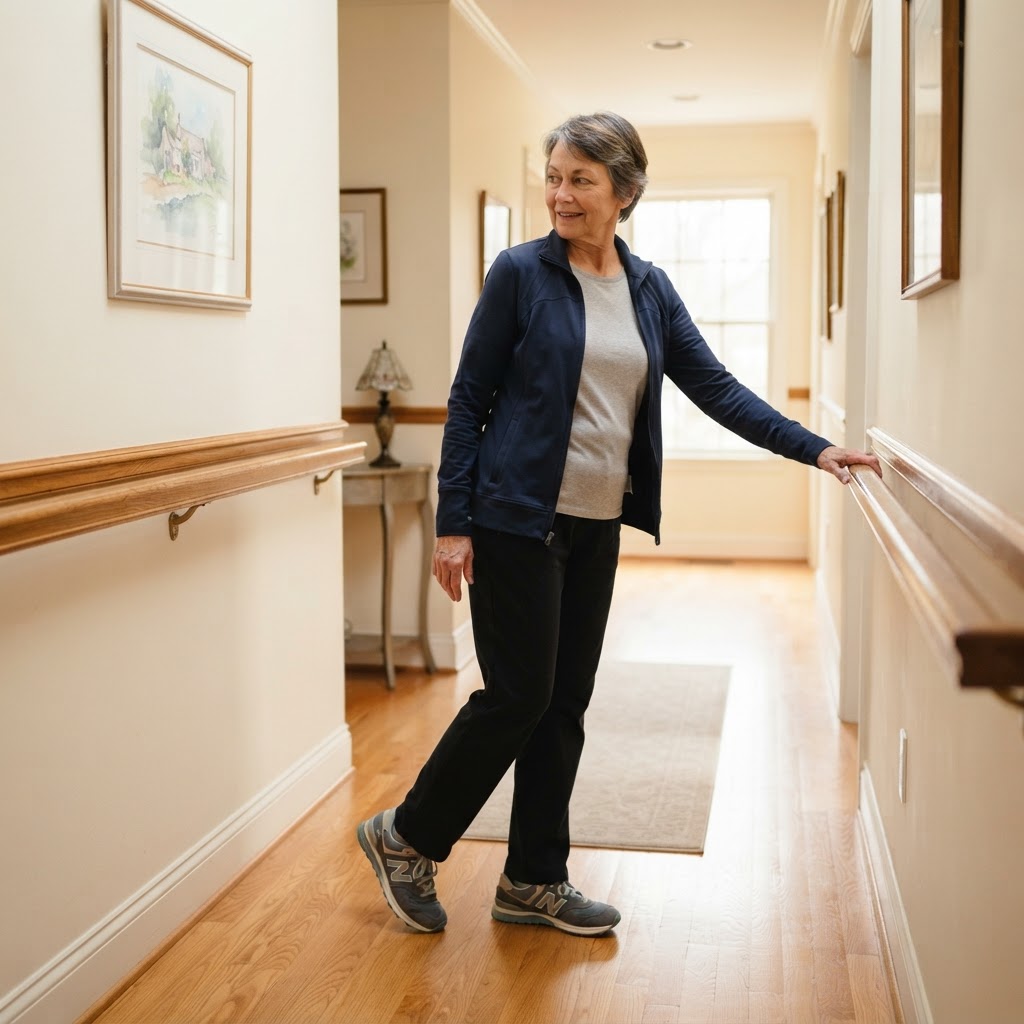
Why Walking Backward Is the Balance Drill Almost Nobody Practices
Toe first. Then heel. Now step back.
Backward walking looks simple, and that's exactly why it gets skipped. But it's one of the most valuable drills I give clients — because it trains the direction that forward walking never does.
Think about your average week: thousands of forward steps. To the kitchen, to the car, around the block. How many backward steps? For most people, almost none — unless they're doing a drill like this one.
Why Direction Matters So Much
Your body adapts to what you practice. All that forward walking builds a very efficient forward pattern — and leaves the reverse pattern untrained. But real life doesn't stay forward. You step back from a hot stove, back away from a closing door, back out of a crowded aisle, or step back to catch your balance when something shifts unexpectedly.
When the backward pattern has never been rehearsed, those moments are where people lose their footing. Training it deliberately, with support, is how you make those moments uneventful.
What the Toe-First Reach Actually Does
Here's the detail that makes this drill more than just "walking in reverse": the toe reaches back and touches first, before the heel settles.
That sequence wakes up the foot and ankle and gets them working together. The toe finds the ground, the ankle adjusts to whatever surface it meets, and only then does the heel take the weight. Forward walking never asks your foot to do that kind of probing — your heel lands first and the foot rolls forward on autopilot.
That's why this drill trains:
Foot and ankle control
Toe-first contact engages the foot and ankle as a team on every step.
Weight transfer
Every rep moves your body weight backward, under your control.
Balance and stability
Your standing leg steadies you while the other foot reaches into untrained territory.
Coordination
Both sides of the body learn a pattern they've never rehearsed.
Safety Comes First — Every Single Rep
This is the part I won't compromise on with a backward drill: always hold onto a rail, a counter, or a sturdy chair. Support in reach is not optional, and it's not cheating. The control comes from your standing leg, not from hoping you don't wobble.
Start with five slow backward steps per direction, staying within reach of your support the entire time. When five steps feel boring and controlled, add a few more. Distance and speed come later; control comes first.
Who It's For
Anyone who wants steadier footing when life moves in unexpected directions — especially adults after physical therapy, where backward stepping is often the first "real world" pattern to disappear. It needs nothing more than a hallway, a counter, or a sturdy chair.
Try It With Us
Watch our video demonstrating the full drill with proper support (see our videos page), then try five slow backward steps at home and tell us how it went.
At WellFit ROC, I help adults in Rochester, Webster, Penfield, Pittsford, and the surrounding areas bridge the gap between physical therapy discharge and real-world strength, balance, and confidence — in-home or virtual. If you want a program built around drills like this, book a free consultation.
Jesse Brenon is a Licensed Physical Therapist Assistant (PTA) and NASM-Certified Personal Trainer, and the founder of WellFit ROC.
Ready to take the next step?