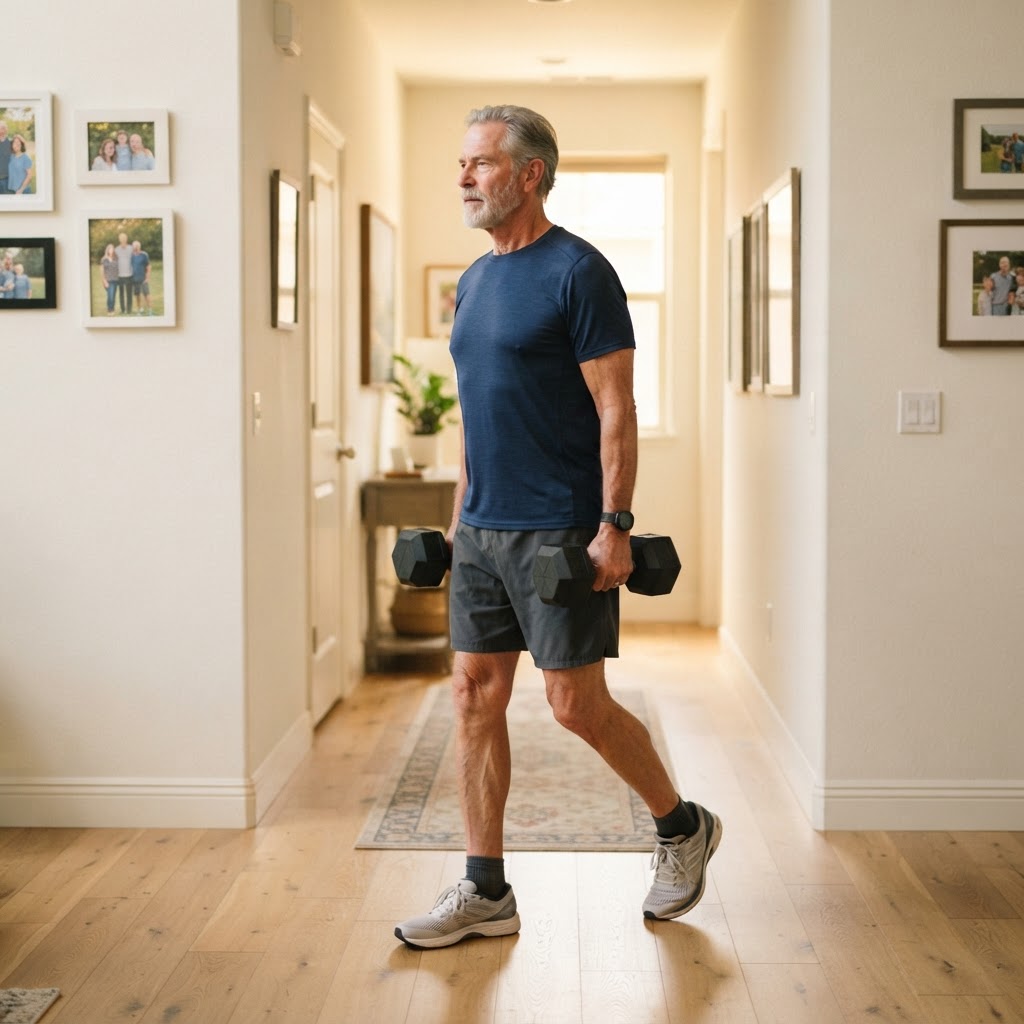
The Farmer Carry Walk: 4 Things Carrying Weights While You Walk Actually Builds
Carry weight. Walk heel to toe. Feel your whole body switch on.
The farmer carry walk is simple on purpose: a weight in each hand and a deliberate heel-then-toe step down the hallway. No equipment beyond a pair of dumbbells, no complicated setup, and nothing that requires a gym.
But simple doesn't mean easy. When you load both hands and walk with intent, your body has to organize grip, posture, and stepping all at once — and that's exactly what makes it valuable.
1. Grip and Forearm Strength
Most strength training involves picking a weight up and putting it down. The farmer carry asks you to hold it for the entire walk — often thirty seconds or more. That sustained demand builds grip and forearm strength in a way single sets of deadlifts won't.
Grip strength matters far beyond the gym. It's a well-documented marker of overall function in aging, and it's what lets you carry grocery bags in from the car without setting them down twice.
2. Trunk and Posture
A heavy weight in each hand is a constant, gentle reminder to stand tall. If you slump, the load pulls you forward. If you lean, it gets harder.
Over the length of a hallway, your trunk and postural muscles learn what "tall and braced" feels like under load — and that carries into everything else you lift and carry during the day.
3. Heel-to-Toe Foot Control
The gait matters as much as the load. A deliberate heel-then-toe step trains your ankle and foot to work through a full, controlled range with every stride, rather than letting your foot slap down wherever it lands.
That toe-off and heel-strike precision is the same skill that keeps you steady on uneven ground.
4. Real-World Carrying Power
Groceries. Laundry baskets. A squirming grandkid. Most of the heavy things in daily life come with a requirement to carry them somewhere, not just lift them.
This drill trains that exact combination: load plus movement. It's the closest thing in your house to walking the bags in from the car.
Safety Comes First
Before trying this drill, make sure you can walk safely unsupported. That's the entry requirement, not a suggestion — this is a loaded drill, and a stumble with weights in both hands is harder to recover from.
Start light, start slow, and stay on a clear flat path. If your balance isn't yet solid without support, hold onto a counter or rail and build that first, then add load.
How to Start
Pick up a weight in each hand you can hold comfortably for the length of your hallway, walk heel to toe with slow controlled steps, then turn around and walk back. Start with five slow steps each way, and add distance or load only once it feels boring and steady.
Try It With Us
Watch our video demonstrating the full walk and the four benefits (see our videos page), then try five slow steps at home and tell us how it went.
At WellFit ROC, I help adults in Rochester, Webster, Penfield, Pittsford, and the surrounding areas bridge the gap between physical therapy discharge and real-world strength, balance, and confidence — in-home or virtual. If you want a program built around drills like this, book a free consultation.
Jesse Brenon is a Licensed Physical Therapist Assistant (PTA) and NASM-Certified Personal Trainer, and the founder of WellFit ROC.
Ready to take the next step?