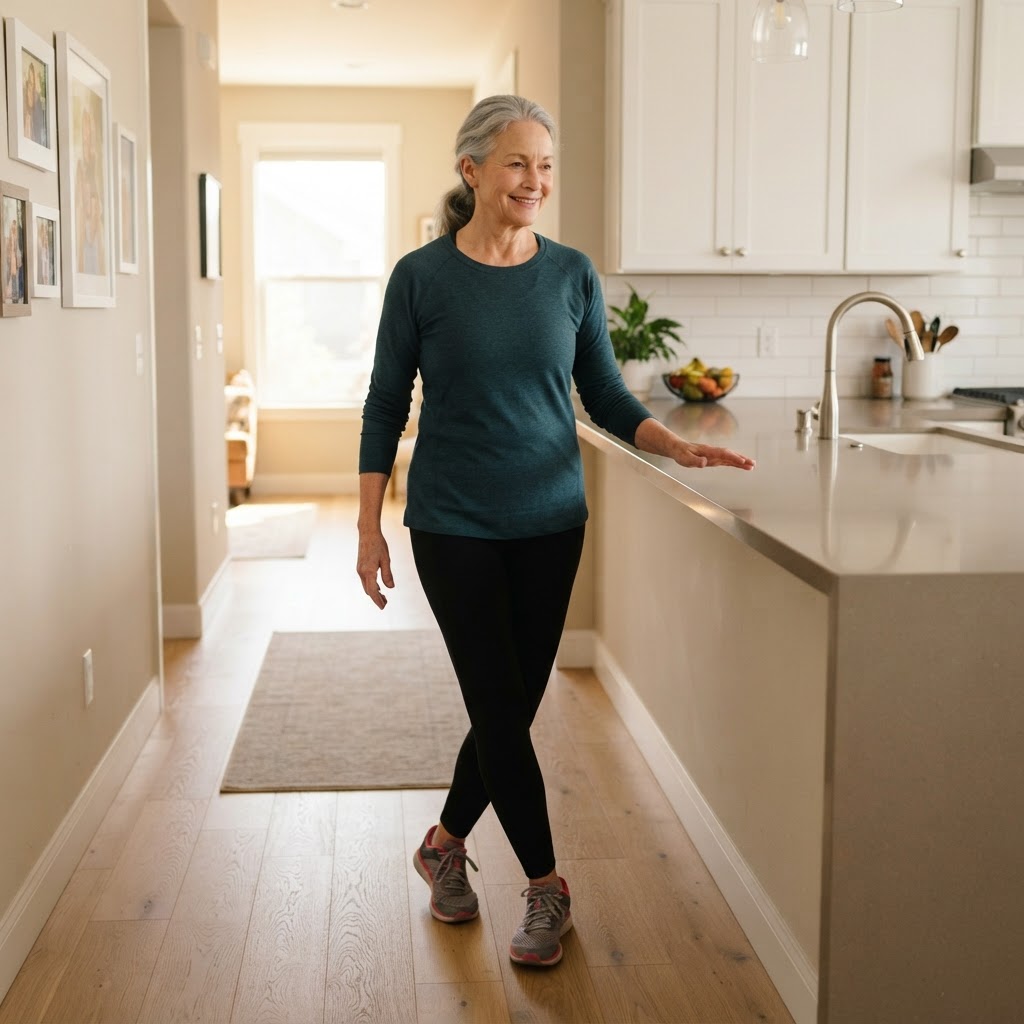
The Dance Step That Helps Prevent Falls: Why the Grapevine Works
Step. Cross behind. Step. Tap.
If you've ever been to a wedding, a line dance class, or an aerobics class in the last 50 years, your feet already know this pattern. It's the grapevine — one of the most common dance steps in the world. And it also happens to be one of the most effective (and most overlooked) balance and coordination drills I give my clients.
Why Sideways Movement Matters So Much
Here's something most people never think about: almost all of our daily walking is forward. To the kitchen. To the mailbox. To the car. Our bodies get thousands of reps of forward stepping every week — and almost zero reps of sideways movement.
But real life doesn't only move forward. You sidestep around a dog, reach sideways for a railing, step around a grandchild's toys, or move over in a crowded grocery aisle. Falls happen most often during these unplanned sideways and turning movements — exactly the patterns that never get trained.
The grapevine fixes that. It's one of the few drills that trains lateral movement the way your body actually has to use it.
What the Grapevine Actually Trains
Hip control where falls start. The cross-behind step — the heart of the grapevine — requires your hip to rotate and control your leg crossing behind your body. That's your glute medius and deep hip rotators doing precise work. Weakness in these muscles is one of the most common findings in clients at fall risk.
Coordination across the body. Crossing one foot behind the other while moving sideways is a "cross-lateral" pattern — it forces the two sides of your body to coordinate in a way forward walking never demands. That coordination is trainable, and it transfers to real-world recovery when you stumble.
Dynamic balance. Unlike standing balance drills, the grapevine keeps your weight shifting side to side for the entire pattern. Your balance system (inner ear, vision, and body sense) has to keep recalibrating the whole time. That's exactly the demand of real life.
Spatial awareness. Placing your foot behind your body without looking means you're training proprioception — your body's internal sense of where your limbs are. This is a skill that quietly fades with age unless you use it.
Why It Builds Confidence, Not Just Balance
In my experience working with adults after physical therapy, the biggest limiter isn't strength — it's confidence. Fear of falling becomes a spiral: people move less, get weaker, and become more likely to fall.
The grapevine attacks that spiral directly. It's done at a wall, counter, or rail, with support in reach. Every successful rep proves to your body that sideways movement is safe. Confidence follows control — and confident people keep moving.
How to Do It Safely
- Stand sideways next to a wall, counter, or sturdy rail, with support in reach.
- Step sideways with your lead foot.
- Cross your other foot BEHIND your lead foot.
- Step sideways again with your lead foot.
- Tap your trailing foot beside it.
- Repeat, then try the other direction.
Progression: Support hand on the rail → hover your hand just above it → arms free → increase distance and tempo. Always train both directions — your body is not symmetrical, and one direction will feel harder. That's normal, and it's useful information.
A few grapevines down a hallway, 2–3 times a week, is a meaningful dose. Coordination first, speed later.
Who It's For
The grapevine scales to almost anyone: clients holding a rail for the first time and athletes doing agility warm-ups use the same pattern at different speeds. For adults 55+, and especially those recovering after physical therapy, it's one of the most efficient drills for fall prevention because it trains four systems — hips, coordination, dynamic balance, and awareness — in one movement.
Try It With Us
Watch our video demonstrating the full pattern with support (see our videos page), then try it at your own hallway wall and tell us how it went.
At WellFit ROC, I help adults in Rochester, Webster, Penfield, Pittsford, and the surrounding areas bridge the gap between physical therapy discharge and real-world strength, balance, and confidence — in-home or virtual. If you or a loved one wants a program built around drills like this, book a free consultation.
Jesse Brenon is a Licensed Physical Therapist Assistant (PTA) and NASM-Certified Personal Trainer, and the founder of WellFit ROC.
Ready to take the next step?